Getting Pre-Approved for a Home Loan in Kansas: A Complete Checklist
Getting Pre-Approved for a Home Loan in Kansas: A Complete Checklist
In Wichita and the surrounding suburbs Andover, Derby, Maize, Haysville, Goddard, and beyond well-priced listings can go under contract quickly, sometimes within a weekend. In those situations, sellers often receive multiple offers and don't treat every offer equally. A buyer who walks in with a verified pre-approval letter gets taken seriously. A buyer who hasn't been through the process yet gets passed over.
Pre-approval isn't just a box to check. It's the financial foundation your entire home search stands on. It gives you a lender's estimate of how much you can borrow, gives your agent leverage at the offer table, and shows sellers that a real lender has reviewed your finances and signed off. Without it, you're essentially window shopping.
This guide walks you through what lenders actually evaluate, which documents to gather before you apply, how to choose a lender, and how to use your pre-approval letter strategically once you have it.
One important note before we start: I'm a Realtor®, not a lender or mortgage professional. The information in this post is for general educational purposes. Any specific questions about your financial situation, loan products, or mortgage costs should go to a licensed mortgage professional not your real estate agent.
What Lenders Actually Evaluate
Before a lender issues a pre-approval letter, they review three core areas of your financial life: your credit, your income relative to your debt, and your employment history.
Credit Score Thresholds by Loan Type
For a conventional loan, most Kansas lenders require a minimum credit score of 620. That gets you in the door, but a score of 740 or higher typically yields the most favorable interest rates. Avoiding private mortgage insurance (PMI) is primarily tied to your loan-to-value ratio generally requiring a down payment of around 20% rather than your credit score alone.
FHA loans are more flexible: a score of 580 or above qualifies you for the standard 3.5% down payment option, and scores between 500 and 579 may still qualify with a 10% down payment.
VA loans don't carry an official federal minimum, but most Kansas lenders set a practical floor around 620 for their own programs. If you're PCSing to McConnell AFB or otherwise using a VA loan in this market, the McConnell AFB relocation guide covers the VA loan process in more detail.
Debt-to-Income Ratio: The Number Most Buyers Overlook
Your debt-to-income ratio (DTI) is calculated by dividing your total monthly debt payments by your gross monthly income. If you bring home $6,000 per month before taxes and carry $1,800 in monthly debt obligations, your DTI is 30%.
Many conventional lenders prefer a DTI near 36% but will approve higher ratios often up to around 43% with compensating factors. FHA lenders commonly target around 43% and some allow up to 45%. A high DTI doesn't automatically end your chances. Compensating factors like a large down payment or strong cash reserves can offset it in the lender's eyes.
Why Employment History Matters
Lenders want to see two years of stable employment in the same field. They're looking for consistency, not just a current paycheck. Gaps in employment history or a recent job change aren't automatic disqualifiers, but they do require a written explanation and documentation. If you changed careers recently but stayed in the same industry, that typically reads better than a full pivot into a new field.
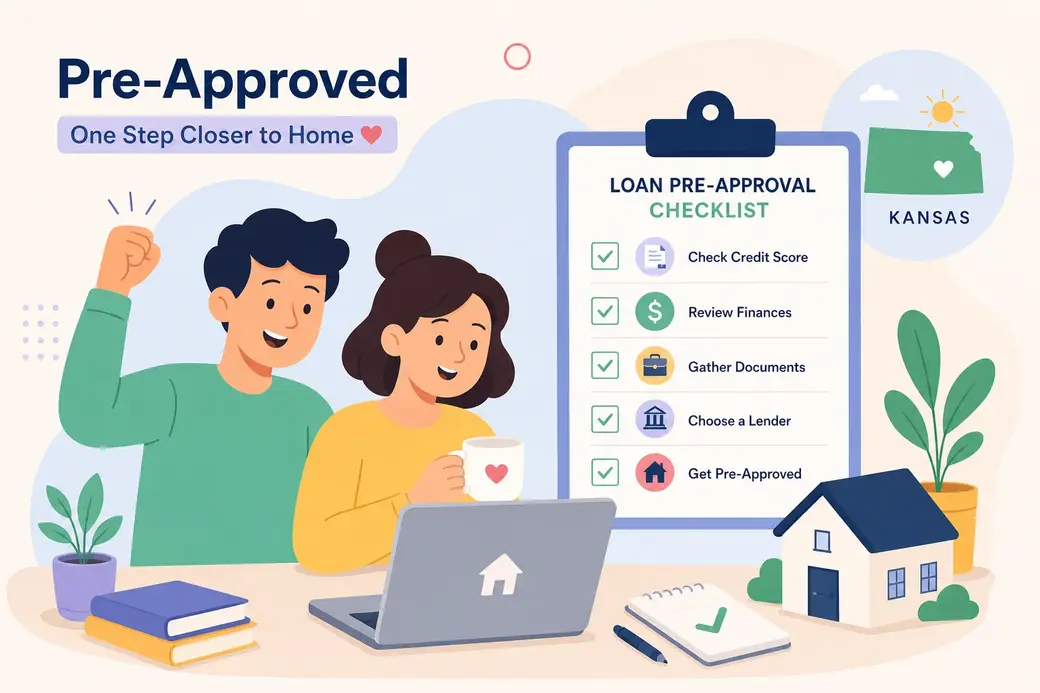
Your Pre-Approval Document Checklist
The single biggest factor in how fast your pre-approval moves is how quickly you submit a complete file. Lenders can't process what they don't have. Organizing everything before you apply saves days of back-and-forth.
Income and employment documents:
- Pay stubs from the last 30 to 60 days
- W-2s and federal tax returns for the past two years
- Employer name and contact information for the past two years
- Self-employed borrowers also need business tax returns, profit-and-loss statements, business bank statements, and proof of business existence such as a business license or secretary of state filing
Self-employed Kansas buyers often face longer pre-approval timelines because lenders verify income through a different set of documents. Having a CPA letter that confirms your business is active and your income is consistent can speed up the review significantly.
Asset and liability records:
- Two to three months of bank statements for all checking, savings, and investment accounts
- Retirement account statements if applicable
- A full list of monthly debts including car loans, credit cards, and student loans
- A gift letter if a family member is contributing any portion of your down payment
Identity and housing history:
- Government-issued photo ID and your Social Security card or number
- If you're currently renting, your lender may ask for your rental payment history or a letter from your landlord
Having everything organized in one folder before you apply digital or paper cuts processing time and signals to the lender that you're a prepared buyer.
Choosing the Right Lender
Where you get pre-approved matters beyond just the interest rate. The lender you choose affects your timeline, your communication experience, and sometimes how a seller perceives your offer.
Local lenders bring familiarity with the Wichita market. They regularly work with Kansas title companies and have established relationships with local real estate agents the kind of professional connections that matter when an underwriting question comes up mid-transaction. A phone call to someone who knows your file and your market can move things forward faster than submitting a ticket in an online queue.
Your choice of lender is entirely yours. I can share lenders I've worked with as a reference point, but I'm not a mortgage professional and don't have a financial relationship with any lender I might mention. My recommendation is always to talk to at least two lenders before committing and it's worth understanding why that comparison matters.
Lenders are not apples to apples. Credit score requirements, loan products, origination fees, lender fees, interest rates, APR, and turn times all vary from lender to lender even for the same loan type. Two buyers applying for the same loan type at two different lenders on the same day can end up with meaningfully different costs and experiences. Comparing at least two gives you a real baseline to evaluate what you're being offered.
You don't need to be under contract to request a closing cost estimate. Ask for one early even before you're actively searching so you understand the general range of what you'll need to bring to closing. That information helps you plan before you're emotionally invested in a specific home.
When you do have a specific property in mind, your estimated monthly payment becomes more accurate because you can factor in property-specific costs. Property taxes vary by address and assessed value. Homeowner's insurance rates vary based on the home's age, construction type, and location. Some communities carry HOA fees. Some properties are subject to special assessments. None of these show up accurately until you have a specific address which is why a general pre-approval gives you range and direction, and a property-specific estimate gives you the full picture.
Any questions about loan costs, rate comparisons, or what you qualify for should go directly to a licensed mortgage professional not your real estate agent. That's the right person to give you answers grounded in your actual financial situation.
A few questions worth asking any lender directly:
- What is your average time from application to pre-approval letter?
- Do you offer in-house underwriting?
- Which loan types do you work with conventional, FHA, VA, USDA?
A lender who avoids answering these questions clearly is telling you something.
Pre-Approval vs. Pre-Qualification: Know the Difference
Pre-qualification uses self-reported information and typically involves only a soft credit pull your score isn't affected. Mortgage pre-approval requires a hard inquiry, which may lower your score by a few points temporarily.
That trade-off is worth it. A pre-approval letter carries actual weight with sellers. A pre-qualification letter is often viewed as little more than a rough estimate.
If you're comparing multiple lenders, don't worry about multiple hard pulls damaging your credit. FICO scoring models group mortgage-related inquiries that occur within a 45-day window and treat them as a single inquiry. The Consumer Financial Protection Bureau provides a clear explanation of how mortgage credit inquiries work if you want to go deeper on that.
How Long Your Pre-Approval Letter Stays Valid
Most lenders issue pre-approval letters valid for 60 to 90 days. Some use a 30-day window. The letter expires because lenders need a current picture of your financial profile before they can stand behind a loan amount. If your home search extends past the expiration date, you'll need to renew with updated documents and likely a new hard credit pull.
Several actions can cancel a pre-approval before it expires:
- Taking on new debt a car loan, new credit card, or furniture financing
- Changing jobs or losing income
- Making large unexplained deposits into your bank accounts
Each of these can raise your DTI past the lender's threshold or trigger additional scrutiny during underwriting. The safest rule: keep your finances exactly as they were when you applied until after you close.
Using Your Pre-Approval Letter Strategically
A pre-approval letter tells a seller that a lender has reviewed your income, credit, and assets and confirmed you meet the requirements for a specific loan amount. That's different from a buyer simply saying they can afford the home. In competitive situations, listing agents routinely advise sellers to prioritize pre-approved offers over pre-qualified ones.
Your pre-approval letter is submitted with your offer. When you write an offer on a home, the letter goes with it it's part of the package that tells the seller you're a qualified, serious buyer. Without it, your offer is at a significant disadvantage in any competitive situation.
A few additional strategies worth knowing:
Match the letter to your offer price. Some agents recommend requesting a letter that supports your specific offer price rather than revealing your full approved amount. Showing a seller your maximum purchasing power hands them information they can use against you in negotiations.
Pair it with a strong earnest money deposit. A pre-approval letter combined with a meaningful earnest money deposit reinforces your commitment in a way that a letter alone doesn't.
Local lender familiarity matters. If your pre-approval comes from a local Kansas lender that the listing agent already knows and trusts, that familiarity can add another layer of confidence to your offer particularly in multiple-offer situations.
FAQ: Getting Pre-Approved for a Home Loan in Kansas
Do I need to be under contract to get pre-approved? No. Pre-approval conversations can and should happen before you've identified a specific property. Starting early clarifies your purchasing power, gives you a realistic sense of your timeline from pre-approval to close, and removes one major variable before you're under the pressure of an active search.
Do I need to be under contract to get a closing cost estimate? No. You can ask any lender for a closing cost estimate at a representative price point before you've found a home. That estimate gives you a useful general range to plan around. Keep in mind it becomes more precise once you have a specific property because taxes, insurance, HOA fees, and other property-specific costs vary by address and can affect your actual monthly payment.
What's the difference between pre-qualification and pre-approval? Pre-qualification uses self-reported information and typically involves a soft credit pull your score isn't affected and the result is a rough estimate. Pre-approval requires a hard credit inquiry and involves a lender actually reviewing your income, assets, and credit. A pre-approval letter carries real weight with sellers. A pre-qualification letter generally doesn't.
Will getting pre-approved hurt my credit score? Pre-approval requires a hard inquiry, which may lower your score by a few points temporarily. If you're comparing multiple lenders, don't let that stop you. FICO scoring models group mortgage-related inquiries within a 45-day window and treat them as a single inquiry so shopping multiple lenders within that window won't compound the impact on your score.
How long is a pre-approval letter valid? Most lenders issue pre-approval letters valid for 60 to 90 days. Some use a 30-day window. If your search extends past the expiration date, you'll need to renew with updated documents and likely a new hard credit pull. Keep your financial situation stable no new debt, no job changes, no large unexplained deposits from the time you apply through closing.
Should I talk to more than one lender? Yes. Lenders are not apples to apples. Credit requirements, loan products, interest rates, origination fees, lender fees, and turn times all vary. Comparing at least two lenders gives you a real baseline for evaluating what you're being offered. Any questions about specific rates, fees, or loan products should go directly to a licensed mortgage professional not your real estate agent.
When is my pre-approval letter actually used? Your pre-approval letter is submitted with your offer when you make an offer on a home. It's part of the package that tells the seller you're a qualified, serious buyer whose financing has been reviewed by a lender. In competitive situations, listing agents routinely advise sellers to prioritize pre-approved offers over pre-qualified ones.
How do I start the home buying process in Wichita? The Home Buyer's Rough Draft is a free resource that walks through the buying process from start to finish no sign-up required. It's the right starting point before any lender or agent conversations begin. You can also browse current Wichita area listings, check the May 2026 Wichita market update to understand what the market looks like right now, or book a discovery call when you're ready to talk specifics.
Ready to Take the Next Step?
If you're still getting oriented on the overall buying process before you talk to any lender, the Home Buyer's Rough Draft walks through how it works from start to finish free, no sign-up required. It's the right starting point before pre-approval conversations begin.
When you're ready to search active listings in the Wichita area, browse current homes here.
For buyers researching the Wichita market more broadly, the Wichita Relocation Guide covers the full metro picture. For a current snapshot of active inventory, median sale prices, and days on market, see the May 2026 Wichita market update.
Suburb-specific guides are available for
Moving to Andover KS — the eastside option. Butler County taxes, the top-ranked school district in the metro, and direct access to east Wichita employment and retail.
Moving to Derby KS — the southside option. Wichita's largest suburb, Sedgwick County taxes, Purple Star-designated school district, and the closest suburb to McConnell AFB and Boeing's south campus.
Moving to Maize KS — the northwest anchor. Strong school district, NewMarket Square access, and one of the fastest-growing communities in the metro.
Moving to Goddard KS — the westside option. Active new construction, direct US-54/400 access, and one of the lowest mill levies in the metro.
Moving to Bel Aire KS — northeast Wichita's closest suburb. Sedgwick County taxes, established neighborhoods, and easy access to the northeast employment and medical corridor.
Moving to Park City KS — the north option. Amazon, CrossWinds Casino, Hartman Arena, and two school district options in an actively developing corridor.
Moving to Valley Center KS — northside with the top-ranked school district in Sedgwick County, Highway 135 access, and an established small-town feel north of the metro.
Moving to Haysville KS — the south US-81 corridor option. Sedgwick County taxes, an established school district with two high schools, a 36,000-square-foot activity center, and I-35 access for buyers whose commute runs the south side of the metro.
The Wichita Home Buyer's Blueprint is a free community for buyers who want to go deeper before any conversation. When you're ready to talk specifics about your home search, book a discovery call or reach out directly at 316-284-7767.
Disclaimer: I am a licensed Realtor® with Real Broker LLC in Kansas not a lender or mortgage professional. This post is for general informational purposes only and does not constitute financial, legal, or mortgage advice. Credit score thresholds, DTI limits, loan program requirements, and fee structures are subject to change and vary by lender. Any questions about your specific loan options, costs, rates, or qualifications should be directed to a licensed mortgage professional not your real estate agent. You have the right to independently research and select any lender, real estate professional, or service provider of your choosing.
Categories
Recent Posts











"I'm a full-time Wichita Realtor® helping relocation buyers, local buyers, and sellers navigate the market with real information instead of pressure. Education first, no pushy sales tactics, and every claim backed by an official source. Whether you're six months out or ready to move now, reach out and let's figure out what's realistic for your situation."